Everything an electrician does rests on three quantities and one relationship between them. Understand these and every circuit you meet becomes readable.
The three quantities
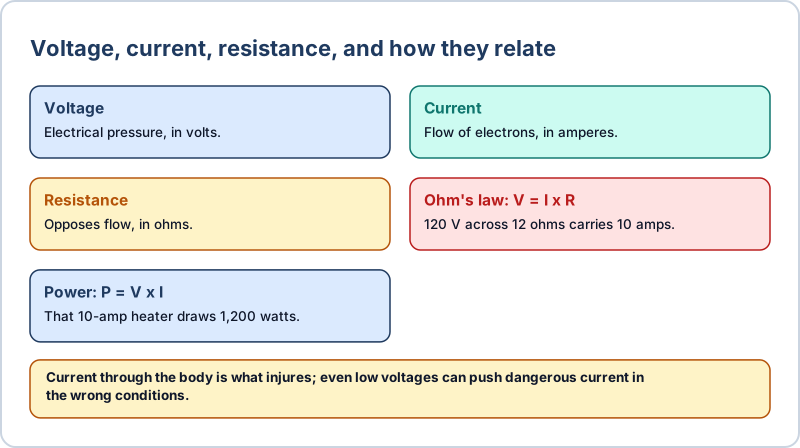
Voltage is electrical pressure, measured in volts. Current is the flow of electrons, measured in amperes. Resistance opposes that flow, measured in ohms. A water analogy helps: pressure, flow rate and pipe narrowness.
Ohm’s law
Voltage equals current times resistance (V = I × R). Rearrange it to find any one value from the other two. A 120-volt circuit feeding a 12-ohm heater carries 10 amps.
Power
Power in watts is voltage times current (P = V × I). That 10-amp heater draws 1,200 watts. Power is what utilities bill for and what makes wires heat up.
Common mistake
Confusing voltage with current when judging danger. Current through the body is what injures; even low voltages can push dangerous current in the wrong conditions.
Key Takeaways
- Voltage is electrical pressure, measured in volts.
- Voltage equals current times resistance (V = I × R).
- Power in watts is voltage times current (P = V × I).
Check Your Understanding
If a heater draws 8 amps on a 240-volt circuit, what is its resistance and power?
Action Step
Work through five Ohm’s law problems using values from household appliances: find current from wattage and voltage, then resistance. Check each answer twice.
This course is educational training. It does not issue a license, certification or credential, and it does not replace state or local licensing requirements, registered apprenticeships or employer safety programs. Always follow the current codes and standards that apply where you work, and never perform work you are not authorized or trained to do. Electrical work can cause fatal injury. Never work on energized equipment; all hands-on practice must be supervised by a licensed electrician in accordance with applicable law.